FREE · PRIVATE
$0forever
Use your own OpenAI API key. No VideoLens account or analysis server.
- ✓ Unlimited BYOK reports
- ✓ Professional HTML and PDF
- ✓ Timestamped evidence and follow-up Q&A
- ✓ Your reports stay on your device
VideoLens sits beside YouTube in Chrome, finds the important ideas and visual details, and builds a polished written report with links to the exact moments that matter.
Chrome will ask you to confirm the free installation.
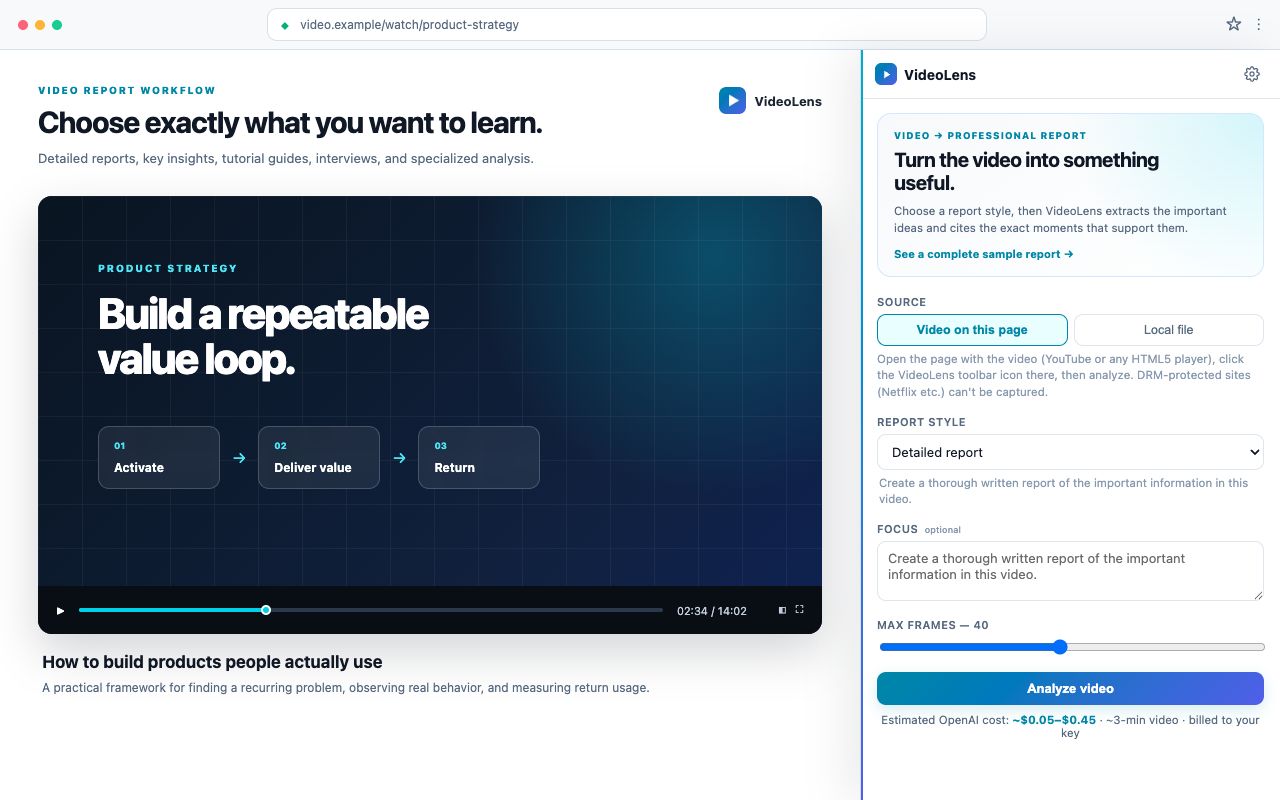
Add VideoLens to Chrome, open a YouTube video, and create your first report. Free private mode stays free forever, and a free account includes one managed starter report.
Sharing VideoLens? Use videolens.io/chrome so the full launch image appears in the link preview.
Keep the source open while VideoLens works beside it.
Detailed report, key insights, tutorial, interview, or a specialized mode.
Jump to cited moments, ask follow-ups, or save professional HTML and PDF.
VideoLens goes beyond a transcript summary by combining speech, frame-level vision, and on-screen text before it writes the report.
Start with the video you do not have time to watch or want to preserve as a readable reference. Local files and many other video platforms remain supported.
Create a detailed report, extract only key insights, turn a tutorial into a guide, or structure an interview or podcast. You can edit the prompt too.
Important claims cite specific timestamps. Jump back to the source, ask follow-up questions, or keep a professional standalone HTML or PDF report.
Resolve the source. Extract everything. Build a timeline. Synthesize a report. Each step is cached at .videolens/cache/<hash>/ so re-runs are cheap and follow-up questions cost cents.
Detects local file, YouTube, Loom, Vimeo, direct URL, generic page. Reports limitations clearly when a site isn't fully supported.
yt-dlp fetches remote video, ffmpeg samples frames and chunks audio, OpenAI transcribes each chunk, GPT-5.4-mini describes every frame and reads any visible text.
Frame summaries and transcript segments are merged into time-windowed segments — each with visual, OCR, transcript, scene type, and confidence.
One GPT-5.6 Terra call against the timeline, your prompt, and the active mode → structured findings, evidence citations, recommendations, and ticket-ready tasks.
A thorough explanation of the thesis, main ideas, supporting examples, caveats, conclusions, and practical takeaways.
Use when you want a lasting written reference, not a five-line summary.
The ideas, facts, examples, and conclusions worth remembering, with repetition and filler removed.
Use when you need the signal quickly but still want evidence.
Prerequisites, ordered steps, exact commands or settings, warnings, examples, and verification checks.
Use when the written instructions are more useful than replaying the tutorial.
The same evidence-grounded engine can handle other sources and specialized questions without complicating the core YouTube-to-report experience.
Detailed summaries, visual context, follow-up questions, and timestamped evidence.
Transcript, frame vision, OCR, and cited reports.
Bug steps, UI evidence, UX friction, and tasks.
Review individual product sessions with evidence.
Give AI agents a structured video-analysis tool.
Turn async recordings into actionable handoffs.
Decisions, objections, commitments, and actions.
Find possible sensitive information before sharing.
Python 3.12+, ffmpeg, and an OpenAI API key. That's the whole list.
# macOS
brew install ffmpeg
git clone https://github.com/shadoprizm/videolens.git
cd videolens
uv sync --extra ui
export OPENAI_API_KEY=sk-...

# Web UI
uv run videolens ui

# Or CLI
uv run videolens analyze "https://youtube.com/watch?v=..." \
  --mode general --prompt "Write a detailed report."
Open the illustrative sample report with no API key or upload. When you're ready, analyze your own YouTube video with your OpenAI API key — it stays in session memory and is never stored by VideoLens.
Paste your OpenAI API key in the sidebar. Calls go straight to OpenAI; you only pay them, not us.
The key lives only in your browser session. Close the tab, it's gone. We don't write it to a database.
Need an OpenAI API key? Get one at platform.openai.com/api-keys · A $5–10 prepaid balance is plenty to test.
The VideoLens extension lives in your browser's side panel. Open a YouTube video or HTML5 player, pick a report style, and get a timestamped, evidence-grounded report without leaving the tab. Local files work too.
Heads-up: DRM-protected players (Netflix, Disney+, …) can't be captured. Live streams aren't supported.
Use your own OpenAI key with no VideoLens account, or create a free account for one managed starter report with no key and no credit card.
Add VideoLens to Chrome, open a YouTube video, and create your first report. Free private mode stays free forever, and a free account includes one managed starter report.
The paid plan removes setup and adds convenience. It does not take the free private product away.
Use your own OpenAI API key. No VideoLens account or analysis server.
Or $99/year. No OpenAI key required. Cancel anytime.
Managed mode sends selected frames, audio or captions, page title, and your prompt through VideoLens to OpenAI. Raw frames and audio are not kept. Cloud report saving is optional and controlled in the extension.
"Analyze once, ask many times" — follow-up questions reuse the cached timeline for cents instead of dollars.
Native Model Context Protocol server so Claude Code, Cursor, and other agents can analyze video as a first-class tool.
Embeddings over processed timelines: "find where they talked about pricing", "find every error message", across your whole library.
PostHog, Clarity, Hotjar, FullStory, LogRocket, and OpenReplay pages can use a browser-capture fallback; native event-export parsers are next.
Everything you need to know about how VideoLens works, what it costs, and how your data is handled.
VideoLens is an open-source video intelligence tool that turns any video into a timestamped, evidence-grounded report. You drop in a video — a local file or a link from roughly 1,500 supported platforms — ask a question, and it returns structured findings that cite specific moments in the video. It's MIT licensed and built for both humans and AI agents.
VideoLens runs a four-stage cached pipeline. It resolves the video source, extracts audio, sampled frames, and on-screen text (OCR), merges them into a time-windowed timeline, then runs one analysis pass against your prompt and chosen mode to produce findings with timestamp citations. Each step is cached, so re-runs are cheap and follow-up questions cost only cents.
Yes. Private BYOK mode and the MIT-licensed core stay free. You pay OpenAI directly for your own model usage. A signed-in account includes one managed starter report, and optional VideoLens Pro is $12/month or $99/year for 20 managed reports per calendar month with no API key required.
Local files plus roughly 1,500 platforms via yt-dlp, including YouTube, Loom, Vimeo, TikTok, Twitch, Twitter/X, Reddit, and Google Drive. DRM-protected players such as Netflix and Disney+, and live streams, are not supported.
It depends on the mode you choose. Private BYOK mode has no VideoLens analysis server: content goes directly from Chrome to OpenAI and reports stay on your device. Pro Managed mode sends the required content through VideoLens to OpenAI. Raw media is not kept, and completed reports enter your cloud library only when you explicitly enable cloud saving.
Analysis costs go straight to your own OpenAI account, typically $0.05–$1.50 per video. A 5-minute clip with 20 frames is about $0.20; a 30-minute meeting is roughly $0.50–$1.50. Cached timelines make follow-up questions on the same video cost only cents.
Yes. VideoLens outputs structured JSON with evidence citations and ships a native Model Context Protocol (MCP) server, so agents such as Claude Code and Cursor can analyze video as a first-class tool.